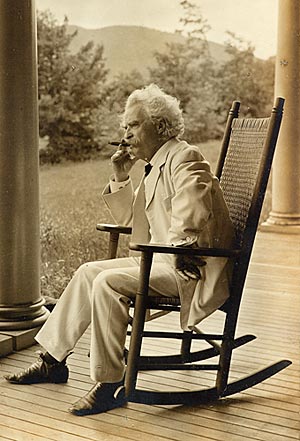
Long before interstate highways, automobiles, and airplanes changed the way Americans traveled, the Mississippi River was one of the great transportation corridors of the United States. Steamboats moved passengers, mail, cotton, timber, livestock, and manufactured goods between the communities lining the river, and towns fortunate enough to have a good landing could become important centers of commerce. Helena, Arkansas, was one of those towns. During the nineteenth century, its location on the Mississippi and at the edge of the rich agricultural lands of the Delta made Helena an important river port, bringing thousands of travelers through the community. One of those travelers would eventually become one of the most famous writers in American history.
His name was Samuel Langhorne Clemens, although most of the world would come to know him as Mark Twain.
Twain is usually associated with Hannibal, Missouri, and with books such as The Adventures of Tom Sawyer, Adventures of Huckleberry Finn, and Life on the Mississippi. Before becoming a famous author, however, he was a Mississippi River steamboat pilot, and Helena was part of the river he had to learn. Years later, after becoming internationally famous, Twain returned to the Mississippi and stepped ashore in Helena. The description he left behind provides us with a remarkable glimpse of the city during one of the most important periods in its history.
Twain Knew Helena Before He Became Famous
Samuel Clemens became fascinated with steamboats as a young man and began learning to pilot them during the late 1850s. Becoming a Mississippi River pilot was not a matter of simply learning how to steer a boat. Pilots were responsible for safely guiding enormous vessels through a river that was constantly changing. They had to memorize bends, crossings, islands, sandbars, landmarks, currents, channels, and countless other details along hundreds of miles of river.
The Mississippi could change dramatically from one season to another. A channel that had been safe during high water might become dangerous when the river dropped. Sandbars appeared where deep water had existed before, while floods could alter shorelines and change familiar landmarks. A good pilot therefore had to develop an intimate knowledge of the river, particularly along the heavily traveled route between St. Louis and New Orleans.
That route carried Clemens directly past Helena.
In Life on the Mississippi, Twain recalled a piloting episode involving a steamboat approaching Helena at night when the river was low. He described the crossing above Helena as difficult and tangled, illustrating just how complicated navigation could become along this portion of the Mississippi. The story was written with Twain’s characteristic humor, but behind the humor is an important historical detail: Helena was part of the working river that Samuel Clemens knew before anyone knew him as Mark Twain.
For a young pilot, Helena was not simply another name on a map. It was a landmark along a river that had to be memorized.
More than twenty years later, Twain returned.
Mark Twain Returns to the Mississippi
By 1882, Samuel Clemens’s life had changed completely. The young river pilot had become Mark Twain, one of America’s best-known writers. More than two decades had passed since his days in the pilot house when he decided to travel the Mississippi again, revisiting the towns and stretches of river he remembered from his youth.
Twain wanted to see what had changed. The Civil War had transformed the South, railroads were expanding rapidly, and the great age of the Mississippi steamboat was beginning to give way to new forms of transportation. He also wanted to gather material for what would become Life on the Mississippi, his combination of memoir, history, humor, travel writing, and observations about the changing river.
During that journey, his steamboat stopped at Helena to unload freight. Twain went ashore and had approximately two hours to walk around town.
It may not sound like much time, but Twain was an exceptionally observant traveler. He noticed things that other people might have walked past without a second thought, and what he recorded about Helena gives us an unusually vivid picture of the community in 1882.
His first impression was especially complimentary. Twain wrote that “Helena occupies one of the prettiest situations on the Mississippi.”
Anyone familiar with Helena can understand what caught his attention. Much of the Arkansas Delta is remarkably flat, but Helena sits against the southern end of Crowley’s Ridge, where the hills rise abruptly above the Mississippi River floodplain. Twain noticed the unusual geography and described Helena as occupying the southernmost group of hills visible along that side of the river.
For a man who had traveled hundreds of miles of the Mississippi and had seen virtually every important river town between St. Louis and New Orleans, describing Helena’s location as one of the prettiest on the river was quite a compliment.
Helena in 1882
The Helena Twain encountered was not looking its best. The Mississippi had recently flooded, and the town was still dealing with the aftermath. Water had entered streets and buildings, leaving stains that showed how high the river had risen. Boats and scows used during the flood had been left stranded when the water receded, while wooden sidewalks had been damaged or displaced. Mud and pools of stagnant water remained throughout portions of the community.
Twain’s description captures something anyone familiar with the Delta understands: the Mississippi River has always been both a source of opportunity and a source of danger. The river created Helena’s economy, transported its cotton, brought travelers and merchandise into town, and connected the Arkansas Delta with distant markets. At the same time, that same river could rise and overwhelm the community.
The flood damage did not prevent Twain from enjoying his visit. He walked through town on a sunny Sunday while his steamboat unloaded freight, observing the streets, buildings, residents, and businesses. His writing gives us something more valuable than a simple list of historical facts because he describes Helena as a living community rather than as a collection of dates and statistics.
Through Twain’s eyes, we can briefly imagine what it must have been like to walk those streets more than 140 years ago.
A Busy Mississippi River Town
One of the most interesting parts of Twain’s account is his description of Helena’s economy. Modern visitors may find it difficult to imagine the amount of commerce that once moved through the city, but nineteenth-century Helena was an important commercial center for the surrounding Delta.
Twain described Helena as the second-largest town in Arkansas and reported a population of approximately 5,000 people. Cotton dominated the regional economy, and he wrote that Helena handled between 40,000 and 60,000 bales of cotton each year. The town also conducted substantial business in lumber and grain.
Helena was more than an agricultural shipping point. Twain noted the presence of oil mills, machine shops, a foundry, wagon factories, and other manufacturing operations. He reported approximately a million dollars invested in manufacturing and cited annual gross receipts from Helena’s various businesses at around four million dollars, substantial figures for a town of its size in the early 1880s.
Two railroads served the community, adding another important transportation connection. Helena therefore occupied an advantageous position where the agricultural economy of the Delta, Mississippi River transportation, and the growing railroad system came together.
That combination made the city important.
Cotton grown throughout eastern Arkansas could be brought into Helena, stored, processed, sold, and shipped to distant markets. Steamboats arrived carrying passengers and manufactured goods and departed carrying agricultural commodities. Merchants, warehouse operators, bankers, mechanics, hotel owners, laborers, riverboat crews, and countless other people made their living from the commerce flowing through town.
Mark Twain arrived while much of that world was still alive.
A Tragic Connection Near Helena
Twain’s relationship with this portion of the Mississippi was not entirely nostalgic. Years before his 1882 visit, the river near Helena had been the setting for one of the most painful events of his life.
Twain’s younger brother, Henry Clemens, worked as a clerk aboard the steamboat Pennsylvania. Samuel had previously served aboard the same vessel as a cub pilot and had helped Henry obtain employment on the boat.
On June 13, 1858, the Pennsylvania was traveling up the Mississippi when its boilers exploded near Ship Island, north of Helena. The explosion devastated the vessel and killed scores of passengers and crew members. Henry survived the initial blast but suffered severe injuries.
Samuel was in New Orleans when news of the disaster reached him. He hurried north and eventually reached Memphis, where Henry had been taken with other survivors. Henry died from his injuries several days later, on June 21. He was only 19 years old.
His death affected Samuel Clemens deeply. Because Samuel had helped Henry obtain the job aboard the Pennsylvania, he carried considerable guilt over what happened. The tragedy became part of the emotional history of Twain’s relationship with the Mississippi River, a place he loved deeply but also understood could be extraordinarily dangerous.
That tragedy occurred north of Helena more than twenty years before Twain returned to the city as a famous writer. We cannot know precisely what memories crossed his mind as his steamboat traveled through those waters again, but the river surrounding Helena was certainly not unfamiliar territory to him.
Seeing Old Helena Through Twain’s Eyes
What makes Twain’s account so valuable today is the opportunity it gives us to imagine Helena during the height of its river-port era. We can picture steamboats tied along the waterfront while crews unloaded freight. Cotton was moving through warehouses toward the river, merchants were conducting business downtown, and trains were connecting Helena with communities beyond the Mississippi.
The town itself was still recovering from the flood. Mud covered portions of the streets, elevated wooden sidewalks crossed wet areas, and marks on buildings showed where the water had recently stood. Behind the city rose the hills of Crowley’s Ridge, while in front of it flowed the river responsible for much of Helena’s prosperity.
Into that scene walked Mark Twain.
He was only there for a couple of hours, but that short visit created a written snapshot of Helena that has survived for generations. Twain wasn’t trying to write the definitive history of the city. He was simply observing what was around him, which is precisely what makes his description so interesting. He noticed the flood damage, the people, the geography, and the commerce of the community in much the same way a traveler might describe Helena after spending an afternoon there today.
Then his steamboat finished unloading its freight, Twain returned aboard, and the journey continued.
The River That Built Helena
Twain’s account also reminds us of something fundamental about Helena’s history. The Mississippi River wasn’t merely located beside the city. The river was one of the primary reasons Helena developed into an important community in the first place.
The rich agricultural lands surrounding Helena produced enormous quantities of cotton and other crops, but those commodities had little value unless they could reach a market. Before modern highways and trucks, the Mississippi provided one of the most efficient ways to move large amounts of freight across long distances.
Helena became a natural gathering point for that commerce.
The river brought far more than cotton through town. It brought travelers, merchants, musicians, businessmen, laborers, soldiers, adventurers, and immigrants. It connected Helena with Memphis and St. Louis to the north and with Vicksburg, Natchez, Baton Rouge, and New Orleans to the south.
Those connections helped create the Helena that Twain encountered in 1882.
Eventually, transportation changed. Railroads became increasingly important, followed by automobiles, highways, trucks, and airplanes. The great passenger steamboats gradually disappeared, and the Mississippi River towns that had depended upon them had to adapt to a very different economy.
Twain’s visit occurred while that transition was underway, which makes his observations particularly valuable.
Mark Twain Remembered Helena
Mark Twain visited countless communities during his travels, and many of the places he encountered along the Mississippi have changed dramatically or disappeared altogether. Helena was fortunate enough to be one of the communities he described in Life on the Mississippi.
He remembered it as a busy commercial town recovering from a flood, surrounded by productive agricultural country and positioned at an unusually beautiful location along the river. He noticed its manufacturing, cotton trade, railroads, and people. Most importantly, he preserved those observations in writing.
For anyone interested in Helena’s history, Twain’s account provides something that statistics and old maps cannot. It gives us the impressions of someone who actually stepped off a Mississippi River steamboat and walked through Helena in 1882.
There is also something particularly fitting about Mark Twain being part of Helena’s story. The more you study the history of this little Arkansas Delta town, the more remarkable people seem to appear. Confederate General Patrick Cleburne lived and worked there before the Civil War. Blues musicians later gathered around KFFA and King Biscuit Time. Conway Twitty spent his formative years there. Politicians, professional athletes, writers, businessmen, soldiers, riverboat captains, and musicians all became part of the community’s history.
Mark Twain belongs in that story as well.
Before he became famous, Samuel Clemens knew Helena from the pilot house of a Mississippi River steamboat. More than twenty years later, he returned as Mark Twain, stepped ashore, and spent a couple of hours walking around town. Fortunately for those of us who enjoy digging into the history of Helena and the Arkansas Delta, he took the time to write down what he saw.
More than 140 years later, we can still walk through old Helena with him.
This structure should also work much better for your Cotton Club articles going forward: fewer headings, paragraphs that develop a complete idea before moving on, and transitions that make the piece read as one continuous story rather than a collection of short sections.

Leave a Reply
You must be logged in to post a comment.