Growing up around Helena, Arkansas, you hear a lot of stories. That is simply part of growing up in the Mississippi Delta, where history seems to be attached to nearly every old building, cemetery, stretch of river, and country road. Some of those stories involve the Civil War, the Mississippi River, floods, riverboats, plantations, and families whose names have been part of Phillips County for generations. Others fall somewhere between documented history and local folklore, passed from one generation to another until it becomes difficult to determine exactly where the historical record ends and the legend begins.
One of those stories that has always stayed with me is the story of a dog named Pedro. I first remember hearing about Pedro from my Uncle Gene many years ago. Since then, I have heard several versions of the story, with some details changing depending on who is telling it. Fortunately, the centerpiece of the story is not something that disappeared with time. You can still go to Maple Hill Cemetery in Helena and see it for yourself.
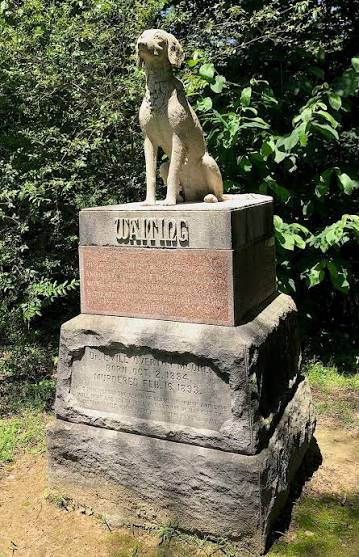
High on Crowley’s Ridge, overlooking the flatlands of the Arkansas Delta, sits the grave of Helena physician Dr. Emile Overton Moore. Atop his monument is a remarkably lifelike stone sculpture of an Irish Setter. The dog’s collar bears the name PEDRO. Carved into the monument beneath him is a single word: WAITING. Elsewhere appears another word: FIDELITY.
Those two words have helped preserve one of Helena’s most memorable stories for more than 130 years.
The Murder of Dr. Moore
Dr. Emile Overton Moore was born on October 2, 1854, and eventually established himself as a physician in Helena. His life came to a violent end on February 16, 1893, when he was killed following a dispute with another Helena physician, Dr. C. R. Shinault. Historical accounts associate the confrontation with a professional disagreement involving the treatment of a patient.
Moore’s family made no effort to conceal the circumstances surrounding his death. His monument at Maple Hill plainly declares that he was “MURDERED FEB. 16, 1893.” Other inscriptions reflected the anger surrounding the killing and suggested that Moore’s family believed additional people may have played some part in the events that led to his death. Historical descriptions of the monument indicate that it may once have contained even stronger language than what survives today.
A killing involving two local physicians must have been a major story in Helena in 1893. Yet, strangely enough, the part of the story that people continued telling generations later was not primarily about the doctors or their dispute. Instead, it was about what supposedly happened after Moore was buried—and about the dog who could not understand why his master never came home.
Pedro Begins His Wait
Pedro was Dr. Moore’s Irish Setter, and his connection to Moore is more than local folklore. The stone dog on Moore’s monument is identified by name, and the sculpture itself has been documented historically. Someone who knew Moore clearly considered Pedro important enough to make the dog a permanent and unusually prominent part of his memorial.
According to the story passed down in Helena, Pedro was devastated by the disappearance of his master. After Moore was buried at Maple Hill Cemetery, the dog supposedly found his way to the gravesite and refused to leave. Pedro remained near the grave, watching and waiting for the man he had followed and trusted to return.
As the story goes, days became weeks and weeks became months. People living nearby began bringing Pedro food and water because he continued to stay around the cemetery. Some versions of the story say that residents could hear the dog’s mournful howls coming from Maple Hill at night. To Pedro, his master was not dead in the human understanding of the word. Dr. Moore was simply gone, and Pedro was waiting for him to come back.
The traditional Helena story says that Pedro maintained his vigil for approximately two years. Eventually, the day came when the faithful dog was reportedly found dead near his master’s grave. According to local tradition, Pedro was buried nearby, ending the long wait that would ultimately become part of Helena folklore.
“Waiting” and “Fidelity”
The monument makes much more sense once you know the story. Pedro is not carved lying peacefully at his master’s feet. Instead, he sits upright with his head raised, appearing alert and attentive. He looks almost as though he is watching the cemetery road, expecting someone familiar to appear in the distance.
Then there are those two carefully chosen words: WAITING and FIDELITY. They communicate an entire story without requiring a lengthy inscription. Waiting describes what Pedro was remembered for doing, while fidelity describes why he did it. Together, the words represent loyalty, devotion, patience, and the bond between a man and his dog.
Anyone who has ever had a dog that was deeply attached to them can understand why the story has survived. Dogs recognize our routines, our voices, our footsteps, and even the sound of our vehicles approaching home. They wait at doors and windows for us to return. What they cannot understand is why someone they love might suddenly disappear forever.
That is what makes the image of Pedro sitting beside Moore’s grave so powerful. Whether every detail of the story happened exactly as it has been repeated over the years, the idea behind the monument is immediately understandable.
Where History Meets Helena Folklore
As with many old Delta stories, it is important to separate what can be documented from what has been preserved through oral tradition. We know that Dr. Moore was a real Helena physician and that he died violently on February 16, 1893. We know Pedro was associated with him because the dog’s name appears on the monument. Most importantly, we know that someone deliberately commissioned a substantial stone sculpture of Pedro and connected that sculpture with the words WAITING and FIDELITY.
What is harder to establish from contemporary records is whether Pedro literally remained at Maple Hill for two full years, whether Helena residents regularly brought him food, whether his howls could actually be heard across the cemetery at night, and whether he ultimately died beside Moore’s grave. Those details have largely survived through the stories people in Helena told one another.
That does not necessarily mean the story is untrue. Oral history often preserves the basic substance of an event even as individual details change over time. In Pedro’s case, the monument itself provides compelling evidence that there was a remarkable story of loyalty behind it. Otherwise, why would someone have gone to the considerable trouble and expense of placing a stone representation of this particular dog on Moore’s grave and carving the words WAITING and FIDELITY into the memorial?
The complete story may have faded with the generations that originally knew Dr. Moore and Pedro, but the monument has not.
History Is Everywhere in Helena
One of the things I have always appreciated about Helena is the incredible amount of history concentrated in such a relatively small place. From the heights of Crowley’s Ridge, you can look toward the Mississippi River and see a landscape that played an important role in the history of Arkansas and the nation. During the Civil War, Helena became a major Union stronghold on the Mississippi, and the Battle of Helena was fought there on July 4, 1863.
Maple Hill Cemetery reflects much of that history. Confederate Major General Patrick Cleburne, who lived in Helena before the war and became one of the best-known commanders in the Army of Tennessee, is buried there. Confederate Major General Thomas C. Hindman and Brigadier General James C. Tappan are also buried at Maple Hill. Nearby, the Helena Confederate Cemetery contains the remains of soldiers, many of whom died during or following the Battle of Helena.
Those are the kinds of names that appear in history books, but places like Maple Hill remind us that history is not made up exclusively of generals, battles, politicians, and dates. Sometimes the smaller stories tell us something equally important about the people who lived before us. Sometimes history is as simple and personal as a man, his dog, and the bond between them.
Pedro Doesn’t Need a Ghost Story
Over the years, Pedro’s grave has occasionally been included among Arkansas legends, cemetery mysteries, and ghost stories. I have never thought the story needed anything supernatural added to it. The story as it has been passed down is powerful enough on its own.
A man died unexpectedly and violently. His dog did not understand where he had gone. According to generations of Helena storytellers, Pedro went to the last place where his master could be found and waited for him. People cared for the dog, but nobody could give Pedro the one thing he wanted—the return of Dr. Moore.
Eventually, Pedro died too. What remained was a story about loyalty that Moore’s family and friends chose to preserve in stone.
There is something almost universal about that. Anyone who has ever watched a dog sit at a window waiting for someone to come home can understand it. More than a century separates us from Pedro, but the behavior behind the story is something dog owners still recognize immediately.
Go See Pedro for Yourself
If you find yourself in Helena-West Helena and have an interest in Arkansas or Delta history, Maple Hill Cemetery is worth taking the time to explore. Don’t simply visit one of the famous Civil War graves and leave. Walk through the cemetery, read the old stones, study the family names, and consider the generations of people whose lives unfolded along the Mississippi River and across the fields of Phillips County.
Then find the grave of Dr. Emile Overton Moore.
You will know you have found it when you see the dog sitting above him. Take a moment to look closely at Pedro. Notice how he is positioned, read the name carved into his collar, and then look at the words that were chosen to explain why he is there.
WAITING.
FIDELITY.
More than 130 years have passed since Dr. Moore was killed. The Helena that he and Pedro knew has changed dramatically. Generations have come and gone, the Mississippi River has continued its relentless movement past the Delta, and many of the people who once knew the complete story have long since joined Moore at Maple Hill.
Pedro, however, remains at his post.
He is still sitting high on Crowley’s Ridge, watching over his master.
And, at least in stone, Pedro is still waiting.

Leave a Reply
You must be logged in to post a comment.