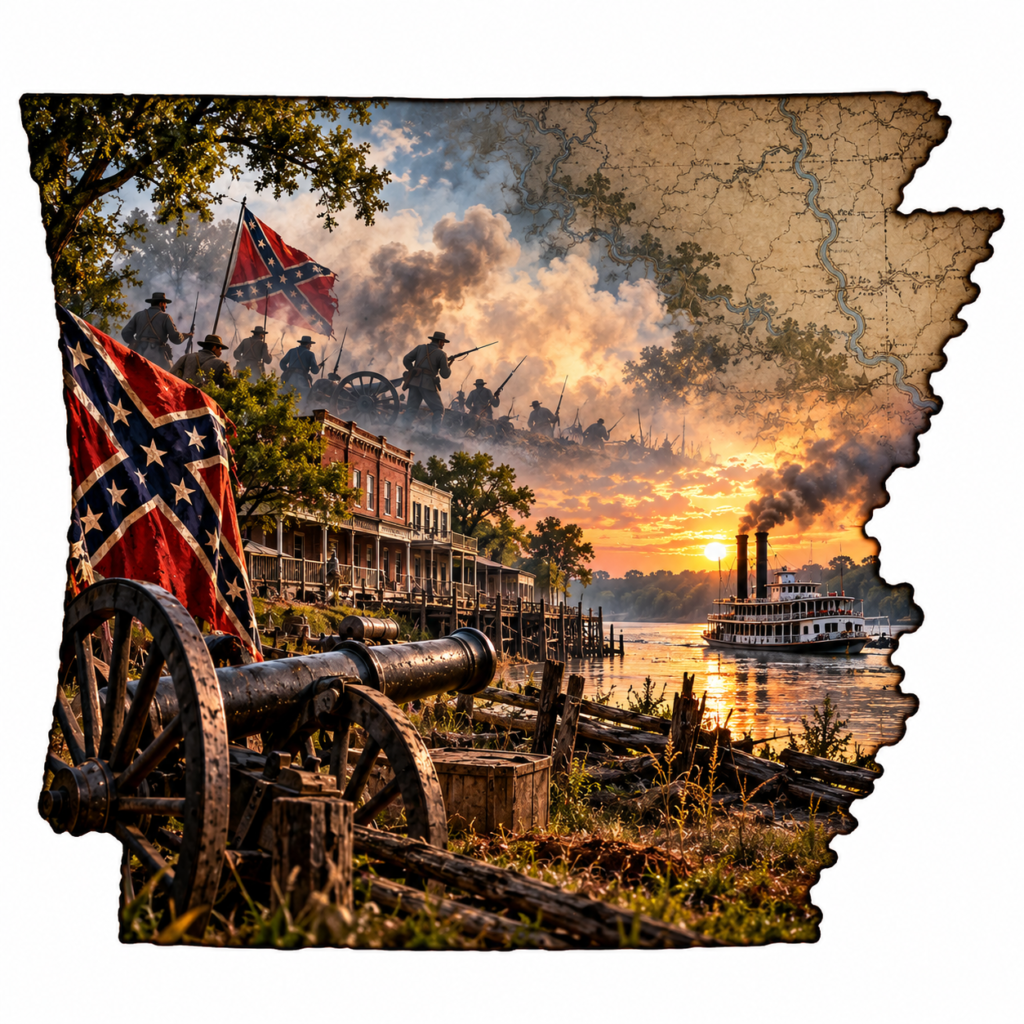
As many of you might already be aware, I’m a huge history buff. I plan to start dropping some historical content here from time to time (especially on topics related to my hometown). I hope you enjoy, and if you have questions or ideas for new content, please don’t hesitate to drop me a note!
Helena, Arkansas played an outsized strategic role in the Civil War, especially after Union forces occupied the city in July 1862. Its location on the Mississippi River, its proximity to the Mississippi Delta, and the high ground of Crowley’s Ridge made Helena one of the Union’s most important bases west of the river.
Helena becomes a Union stronghold
Before the war, Helena was the largest Arkansas town on the Mississippi River and an important commercial center for the surrounding plantation economy. On July 12, 1862, Major General Samuel R. Curtis and the Union Army of the Southwest reached Helena after their long campaign across Arkansas. The Federals occupied the city and would hold it continuously for the remainder of the war. (Encyclopedia of Arkansas)
That changed Helena from a Confederate river town into a major Federal military installation.
Its location was particularly valuable because Helena sat:
- directly on the Mississippi River
- roughly between Memphis and Vicksburg
- adjacent to the enormously productive Arkansas and Mississippi Delta
- on the eastern edge of Crowley’s Ridge, giving Union forces commanding defensive high ground
The Union constructed a network of defenses including Fort Curtis and Batteries A, B, C, and D around the city. (Encyclopedia of Arkansas)
A staging base for the Vicksburg Campaign
One of Helena’s most important functions was logistical. The city became a supply depot and operating base for Union forces campaigning along the Mississippi River, including operations associated with the campaign against Vicksburg.
Federal troops regularly left Helena on expeditions into eastern Arkansas and across the river into Mississippi. It was therefore much more than a defensive garrison—it was a base from which the Union could project military power throughout the Delta. (Encyclopedia of Arkansas)
That mattered enormously because control of the Mississippi was one of the Union’s principal strategic objectives. Capturing Vicksburg and Port Hudson ultimately allowed the Union to control the river and effectively divide the Confederacy. (National Park Service)
The Battle of Helena — July 4, 1863
The biggest event was the Battle of Helena, fought on July 4, 1863.
Confederate Lieutenant General Theophilus Holmes attacked the Union defenses commanded by Major General Benjamin Prentiss. One purpose of the offensive was to threaten an important Union base and relieve pressure associated with the siege of Vicksburg. (National Park Service)
The Confederates attacked the fortified hills surrounding Helena and succeeded in taking part of the Union defensive system, but Federal artillery, infantry and gunfire associated with the river defenses ultimately broke up the assault.
The result was a substantial Confederate defeat.
The National Park Service estimates approximately 1,875 total casualties—239 Union and 1,636 Confederate. The Encyclopedia of Arkansas gives a very similar Confederate figure of 1,614. Differences like this are common in Civil War casualty accounting. (National Park Service)
The timing was remarkable: Vicksburg surrendered to Ulysses S. Grant that same day, July 4, 1863, while Gettysburg had concluded the previous day. Consequently, Helena’s battle has often been overshadowed by those much larger events. (National Park Service)
The Confederate defeat meant Helena remained an important Union enclave in the Trans-Mississippi theater.
Helena and emancipation
There’s another part of Helena’s Civil War history that’s arguably just as important as the battle.
As Curtis’s army crossed Arkansas, enslaved people fled plantations and followed the Union army. When the army reached Helena in 1862, more than 2,000 formerly enslaved people accompanied it, with thousands more eventually seeking protection around the city. Helena developed into the most important refugee center for formerly enslaved people in Arkansas. (Encyclopedia of Arkansas)
These settlements were commonly called contraband camps.
Conditions could be extremely difficult. Housing, sanitation, food and disease were persistent problems. Nevertheless, Union-controlled Helena represented a path from slavery toward freedom for thousands of people from plantations in Arkansas and Mississippi. (Encyclopedia of Arkansas)
Helena also became an important recruiting center for Black Union soldiers. The first of six Black Arkansas volunteer regiments began organizing at Helena in April 1863. More than 5,500 Black Arkansans ultimately served in Union military forces. (Encyclopedia of Arkansas)
Helena helped lead to the capture of Little Rock
After surviving the Confederate attack, Helena continued serving as a Union base.
The National Park Service notes that Helena subsequently served as a base for the expedition that captured Little Rock in September 1863. (National Park Service)
So Helena effectively provided the Union with a secure Mississippi River foothold from which it could push westward into Arkansas while simultaneously supporting operations along the river and into Mississippi.
Why Helena mattered
In practical terms, Helena performed several roles simultaneously: it was a Mississippi River supply depot, fortified Union stronghold, staging area for operations into the Delta, base supporting the Vicksburg campaign, launching point for operations toward Little Rock, refugee center for formerly enslaved people, and recruiting center for Black Union troops.
That combination makes Helena one of the most historically significant Civil War locations in Arkansas.
And there’s an interesting connection to the Arkansas Delta specifically: Union troops based at Helena conducted numerous expeditions into the surrounding plantations, while military farm colonies and freedmen’s settlements began changing the plantation labor system even before the war ended. (Encyclopedia of Arkansas)

If you are interested in civil war relics, shop my marketplace…

Leave a Reply
You must be logged in to post a comment.