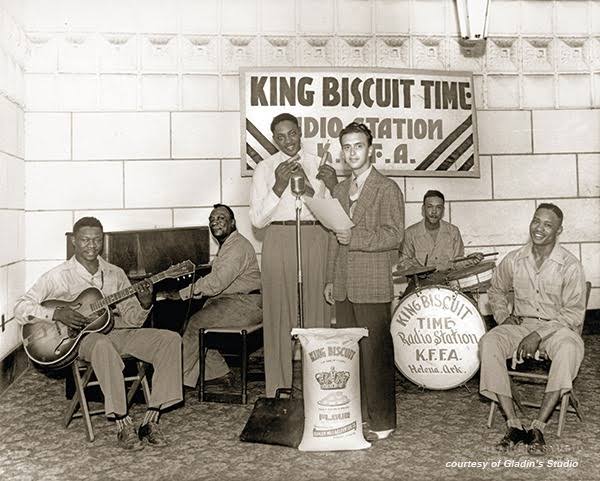
There are certain moments in history that seem ordinary when they happen. Nobody holds a ceremony, nobody writes down that something important has just occurred, and the people involved usually have no idea that anyone will still be talking about it generations later.
One of those moments happened in Helena, Arkansas, on November 21, 1941.
At 12:15 that afternoon, blues musicians Sonny Boy Williamson II and Robert Lockwood Jr. went on the air at a new Helena radio station called KFFA. Their program lasted only about fifteen minutes. They played the blues, talked a little, promoted their sponsor, and sent their music across the Arkansas and Mississippi Delta.
It would have been easy to dismiss it as another small-town radio program.
Instead, King Biscuit Time became one of the most important blues broadcasts in American history. It gave Black Delta musicians regular access to radio during an era when those opportunities were extremely limited, helped turn Sonny Boy Williamson into a regional celebrity, influenced generations of musicians, and established Helena as one of the important places in the history of the blues.
The story of King Biscuit Time is therefore much bigger than the story of an old radio program. It is the story of how the culture of the Mississippi Delta found a microphone in Helena and began traveling far beyond the fields, juke joints, and communities where the music had been born.
KFFA Comes to Helena
By 1941, radio was transforming American life. Families gathered around radios for news, weather, sports, comedy, music, and entertainment, while advertisers quickly discovered that broadcasting offered an entirely new way to reach customers. Even relatively small communities were beginning to establish local stations.
Helena was particularly well suited for one.
The city sat near the center of a large agricultural region extending across both sides of the Mississippi River. Thousands of people lived and worked on farms and in small Delta communities where radio provided an important connection with the outside world. A station broadcasting from Helena could reach listeners throughout eastern Arkansas and across the river into Mississippi.
KFFA went on the air in November 1941 at 1360 AM. The station was established by the Helena Broadcasting Company, which included Sam Anderson, John Thomas Franklin, and J. Q. Floyd. Anderson became particularly important to the story because two local blues musicians soon approached him with an idea.
They wanted to play blues on the radio.
The musicians were Robert Lockwood Jr., a talented guitarist who had learned directly from legendary bluesman Robert Johnson, and Sonny Boy Williamson II, the mysterious and charismatic harmonica player whose real name was Aleck Miller.
Anderson was willing to give them airtime, but commercial radio had a basic requirement that remains familiar today: somebody had to pay for it.
That led the musicians to a Helena businessman named Max Moore.
King Biscuit Flour Gives the Blues a Sponsor
Moore operated the Interstate Grocer Company, which distributed King Biscuit Flour throughout the region. He understood that a blues program could provide his company with direct access to thousands of Black consumers throughout the Delta.
The arrangement was beautifully simple.
King Biscuit Flour would sponsor the radio program. Sonny Boy Williamson and Robert Lockwood Jr. would provide the music. KFFA would provide the microphone and transmitter.
The sponsor also provided the name.
On November 21, 1941, at 12:15 p.m., King Biscuit Time went on the air.
That particular time of day was important. The broadcast coincided with the lunch break for agricultural workers across the Delta. People working in the fields could stop around noon, eat their lunch, turn on a radio, and hear blues musicians performing live from Helena.
Think about what that meant in 1941.
The blues was already deeply established in Black communities throughout the Delta. Musicians traveled from town to town performing in juke joints, clubs, cafés, house parties, street corners, and anywhere else they could find an audience. Yet Black blues musicians had very few opportunities to perform regularly on commercial radio.
Suddenly, two of them were broadcasting from Helena every weekday.
A person didn’t have to travel to a juke joint to hear Sonny Boy Williamson anymore. If the KFFA signal reached your radio, Sonny Boy could come to you.
Sonny Boy Williamson Becomes a Radio Star
Sonny Boy Williamson was perfectly suited for radio. He was a gifted harmonica player, singer, entertainer, and storyteller with a personality large enough to travel through a radio speaker.
His appearances on King Biscuit Time turned him into a regional celebrity.
The program also demonstrated an early understanding of something musicians still rely upon today: one form of media can promote another. Sonny Boy and the other musicians could perform on KFFA during the day and tell listeners where they would be playing that night. People who heard them on the radio could then travel to see them perform in person.
The arrangement benefited everybody involved.
The musicians gained publicity. KFFA gained listeners. King Biscuit Flour gained customers.
The sponsorship worked so well that Interstate Grocer eventually introduced Sonny Boy Corn Meal, even using Williamson’s image in its marketing. A Black blues musician from the Delta had become recognizable enough through Helena radio to help sell grocery products throughout the region.
That was no small accomplishment in the segregated South of the 1940s.
The King Biscuit Entertainers
Sonny Boy Williamson and Robert Lockwood Jr. were only the beginning. A rotating collection of musicians became associated with the program and with the King Biscuit Entertainers.
Among the musicians who passed through this musical world were Pinetop Perkins, Houston Stackhouse, James “Peck” Curtis, Joe Willie Wilkins, Willie Love, Earl Hooker, and others. Some became major figures in blues history themselves.
Helena consequently became more than simply the location of a radio transmitter. It became a gathering place where musicians could meet, listen to one another, find work, perform, and exchange ideas.
That distinction matters.
Music rarely develops because of a single performer working in isolation. Musical traditions grow when musicians interact. One guitarist learns a lick from another guitarist. A harmonica player hears a different phrasing. A piano player brings a style from another town. Somebody takes an old song and changes the rhythm. Another musician hears it and changes it again.
Helena provided a place where those exchanges could happen, and KFFA gave the music a way to travel.
The station wasn’t simply documenting Delta blues.
KFFA became part of the environment in which Delta blues developed.
The Sound Travels Across the Delta
Radio signals do not recognize state lines.
KFFA’s signal crossed the Mississippi River and reached communities throughout the Delta. A farm family in Arkansas could hear the same program as a listener across the river in Mississippi. Radios in homes, stores, workshops, cafés, and farm buildings carried the sounds coming from Helena.
Some of the people listening were musicians.
Others were children who would become musicians.
That is where the influence of King Biscuit Time becomes difficult to measure but impossible to ignore. The program placed blues music into the everyday lives of thousands of Delta residents. Instead of hearing a musician only when he happened to perform nearby, listeners could hear the blues regularly on the radio.
The timing was particularly important because the musical culture of the Delta was beginning to spread north.
During the Great Migration, hundreds of thousands of African Americans left the rural South for cities including Memphis, St. Louis, Detroit, and Chicago. They carried their culture with them, including the blues.
When Delta musicians reached Chicago, the music changed. Guitars became electric so they could be heard in crowded clubs. Amplified harmonicas became part of the sound. Drums and bass became more prominent. The raw Delta blues evolved into the powerful electric Chicago blues associated with performers such as Muddy Waters, Howlin’ Wolf, Little Walter, and others.
Then another generation began listening.
Young American musicians absorbed the blues. British musicians discovered records by Muddy Waters, Howlin’ Wolf, Robert Johnson, Sonny Boy Williamson, and other Black American performers. The Rolling Stones, Eric Clapton, the Yardbirds, Led Zeppelin, and countless other artists drew heavily from the blues tradition.
The road from Helena to rock and roll was not a straight line, and KFFA certainly did not create that musical transformation by itself. But King Biscuit Time was one of the important channels through which Delta blues musicians reached larger audiences.
That is an extraordinary legacy for a small AM radio station in Helena, Arkansas.
“Sunshine” Sonny Payne Takes the Microphone
There is another person who became almost inseparable from the history of King Biscuit Time.
John William “Sunshine” Sonny Payne began working around KFFA when he was still young. His early responsibilities were hardly glamorous. He worked as a janitor and errand boy, cleaned records, and spent time around the station’s engineers learning how radio worked.
Those humble beginnings eventually led to one of the longest broadcasting careers in American radio.
After serving in the military during World War II and gaining additional broadcasting experience, Payne returned to Helena. In 1951, he became the regular host of King Biscuit Time.
His voice became part of the program.
For generations of listeners, Sonny Payne and King Biscuit Time were practically inseparable. Musicians changed, musical styles evolved, sponsors came and went, and the world outside Helena changed dramatically, but Payne remained behind the microphone.
He ultimately hosted thousands of broadcasts and became one of the great personalities in blues radio.
When Sonny Payne died in 2018 at the age of 92, an extraordinary chapter in Helena broadcasting history came to an end.
But King Biscuit Time continued.
Sonny Boy Comes Home
Sonny Boy Williamson’s own career eventually carried him far beyond Helena. He recorded important blues records, became associated with Chess Records, and performed internationally. During the blues revival of the 1960s, he even traveled to Europe, where British musicians treated American blues performers with enormous admiration.
Near the end of his life, however, Sonny Boy came back to Helena.
In 1965, he returned to King Biscuit Time, reconnecting with the radio program that had helped make him famous throughout the Delta more than two decades earlier.
He died in Helena on May 25, 1965.
There is something fitting about that ending. Sonny Boy Williamson had traveled from the Delta to recording studios and stages far beyond Arkansas, but his story eventually returned to the little river town where a radio microphone had first carried his music across the countryside.
King Biscuit Time Refuses to Disappear
Like many long-running radio programs, King Biscuit Time went through difficult periods. Live musicians were gradually replaced by recordings, and the original format changed as American radio itself changed.
After longtime sponsor Max Moore died in 1979, the program eventually went off the air for a period.
That could easily have been the end of the story.
Instead, King Biscuit Time returned in 1986, with Sonny Payne once again behind the microphone. The revival occurred during a period when Helena was beginning to recognize that its blues history wasn’t merely local nostalgia. It was something culturally important that deserved to be preserved.
That same year, Helena held the first festival that eventually became the King Biscuit Blues Festival.
The connection was obvious. The radio program had spent decades broadcasting Delta blues from Helena. Now musicians and blues fans could come to Helena and celebrate that heritage in person.
What began as a small festival grew into one of the best-known blues events in the country, bringing musicians and visitors from around the world back to the banks of the Mississippi River.
From KFFA to the Delta Cultural Center
The preservation of King Biscuit Time eventually became closely associated with the Delta Cultural Center in downtown Helena.
Beginning in the 1990s, the program was broadcast from the center, and a dedicated King Biscuit Time studio became part of the Delta Cultural Center’s exhibits. Visitors could come to Helena and see the program being produced in the same town where Sonny Boy Williamson and Robert Lockwood Jr. had first taken it on the air decades earlier.
National recognition followed.
In 1992, King Biscuit Time received a George Foster Peabody Award, one of broadcasting’s most prestigious honors. The recognition acknowledged something people in the Delta had understood for years: this little radio program was an important part of American cultural history.
A 1965 King Biscuit Time broadcast featuring Sonny Boy Williamson and other musicians was also selected for preservation in the Library of Congress National Recording Registry, which recognizes recordings considered culturally, historically, or aesthetically significant.
By 2023, King Biscuit Time had reached its 19,000th episode.
Think about that for a moment.
What began as a fifteen-minute sponsored blues program on a new Helena radio station in 1941 survived long enough to produce more than 19,000 broadcasts.
More Than a Radio Show
I think the most important thing to understand about King Biscuit Time is that it could only have happened where it did.
Helena sat at a remarkable cultural crossroads. The Arkansas Delta stretched away from one side of town. Across the Mississippi River was the Mississippi Delta. Memphis was nearby. Black musicians traveled throughout the region playing clubs, cafés, juke joints, dances, and house parties. Agricultural workers formed an enormous audience that understood this music because it came directly from the communities where they lived.
Helena already had the musicians.
What KFFA provided was the microphone.
At 12:15 on the afternoon of November 21, 1941, Sonny Boy Williamson and Robert Lockwood Jr. sat down inside a small radio station in Helena and played the blues.
Somewhere out in the Delta, people stopped working for lunch and turned on their radios.
Farm workers listened. Families listened. Store owners listened. Children listened. Musicians listened.
Nobody involved could possibly have known how American music would evolve during the decades that followed. They couldn’t have known that Delta blues would help shape Chicago blues, rhythm and blues, rock and roll, and generations of popular music around the world.
They were simply making a radio program.
That may be what makes the story so remarkable.
Helena has had many different identities during its long history. It has been a Mississippi River port, a cotton center, a Civil War stronghold, a railroad town, an agricultural marketplace, and the commercial center of a large portion of the Arkansas Delta.
But one of Helena’s greatest contributions to American culture came from a microphone inside a little radio station called KFFA.
For fifteen minutes at lunchtime, the Delta had the airwaves.
And the world eventually heard what the Delta had to say.
The key dates and details here are supported by the Arkansas Delta Cultural Center, Encyclopedia of Arkansas, Library of Congress, and Peabody Awards documentation. In particular, those sources document the November 21, 1941 debut, the Williamson/Lockwood connection, Sonny Payne’s long tenure, the 1992 Peabody recognition, and the preservation of a King Biscuit Time broadcast in the National Recording Registry.

Leave a Reply
You must be logged in to post a comment.