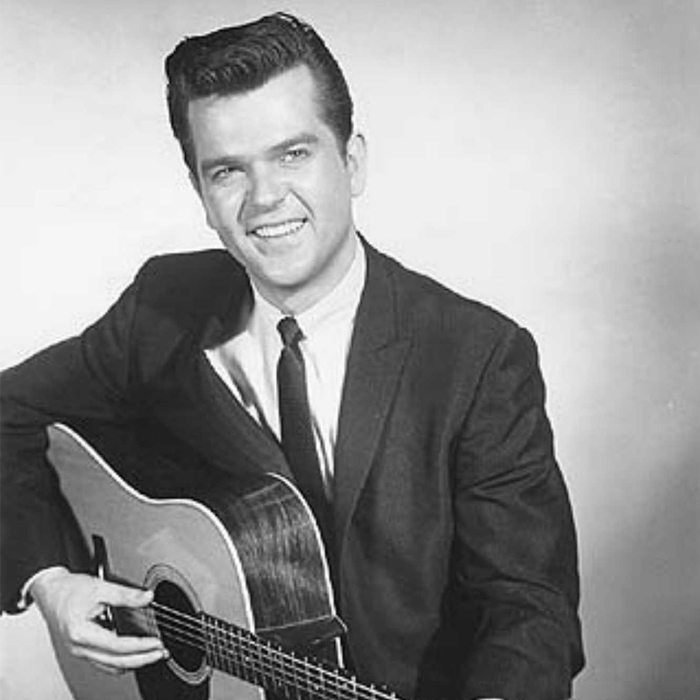
Long before millions of people knew him as Conway Twitty, he was Harold Lloyd Jenkins, a boy growing up in Helena, Arkansas, with a guitar in his hands and an interest in music that was beginning to take over his life. He would eventually become one of the most successful performers in country music history, recording dozens of number-one songs and forming a legendary partnership with Loretta Lynn. Before any of that happened, however, Jenkins spent some of the most important years of his childhood and adolescence in Helena, where he formed his first band, performed on local radio, played baseball, and absorbed the unusual mixture of music that surrounded him in the Arkansas Delta.
Twitty was born Harold Lloyd Jenkins on September 1, 1933, in Friars Point, Mississippi, a small Delta town across the Mississippi River from Arkansas. His family moved to Helena when Harold was about ten years old, placing him in a community that was becoming one of the most interesting musical crossroads in the South. Helena was still very much a cotton and Mississippi River town during the 1940s, but something else was happening there at the same time. Country music, gospel, Delta blues, rhythm and blues, and the earliest ingredients of rock and roll were all being heard within the same relatively small geographic area.
For a young musician, it was a remarkable place to grow up.
KFFA radio had gone on the air in Helena in November 1941, only a couple of years before the Jenkins family arrived. Its most famous program, King Biscuit Time, was already broadcasting the blues of Sonny Boy Williamson II, Robert Lockwood Jr., and other Black Delta musicians across eastern Arkansas and western Mississippi. Country music could also be heard on the radio, while gospel music remained an important part of church life throughout the region. Memphis was only about seventy miles away and was developing its own extraordinary musical culture. All of those sounds overlapped in the Delta, and Harold Jenkins grew up listening to them.
He didn’t remain a listener for very long.
While still young, Jenkins organized a band called the Phillips County Ramblers. Even the band’s name reveals how closely his earliest musical identity was tied to Helena and the surrounding county. These weren’t musicians who had moved to Nashville hoping to become stars. They were young people in Phillips County looking for opportunities to play music wherever they could find an audience.
One of those opportunities came from KFFA.
By the time Jenkins was approximately twelve years old, he was performing on the Helena radio station. The Country Music Hall of Fame specifically records that he was broadcasting over KFFA at age twelve, while other accounts describe Jenkins and the Phillips County Ramblers performing a regular Saturday morning program.
That is one of the most fascinating pieces of Conway Twitty’s Helena story because it places him inside the same radio culture that made Helena famous for the blues. While Sonny Boy Williamson and the musicians associated with King Biscuit Time were broadcasting Delta blues over KFFA, a young Harold Jenkins was learning how to perform for a radio audience on the same station.
Nobody listening to him then could have known where that experience would lead.
Helena Was His Musical Classroom
It would be easy to describe Helena simply as the town where Conway Twitty grew up, but that doesn’t really explain the importance of the place. Helena provided something more valuable than an address. It gave Jenkins access to an unusually diverse musical environment during the years when he was developing his own style.
The Delta has never respected musical categories particularly well. Country, blues, gospel, rhythm and blues, and later rock and roll developed alongside one another, often borrowing rhythms, melodies, instruments, and performance styles from the same regional traditions. The music industry would eventually divide those sounds into separate markets and genres, but a kid growing up around Helena could hear all of them.
Jenkins absorbed that mixture.
Years later, when he first became famous, it wasn’t as a country singer at all. He became a rock-and-roll star. Only afterward did he reinvent himself as the country performer most people remember today. That career makes much more sense when you consider where he grew up. Conway Twitty was comfortable moving between musical styles because Harold Jenkins had grown up in a place where those styles were already living beside one another.
Music wasn’t his only talent. Jenkins was also an excellent baseball player, and for a time it appeared that baseball might become his profession. He played well enough to attract professional attention and reportedly had an opportunity involving the Philadelphia Phillies organization. His plans were interrupted when he was drafted into the United States Army.
Even during his military service, Jenkins continued playing music. By the time he returned to civilian life, American popular music was changing rapidly. Elvis Presley was combining country, blues, and rhythm and blues into something that record companies were beginning to call rock and roll. Just up the road from Helena, Sam Phillips and Sun Records were recording Presley, Johnny Cash, Carl Perkins, Jerry Lee Lewis, and other young musicians who were transforming American music.
Jenkins recognized something familiar in that sound. The mixture that was suddenly exciting teenagers across the country wasn’t entirely new to someone who had grown up in the Delta.
He headed toward Memphis.
From Helena to Rock and Roll
Jenkins eventually recorded at Sun Records, although his breakthrough came after he moved on from the label. By then he had also adopted the stage name that would follow him for the rest of his life: Conway Twitty.
In 1958, Twitty released “It’s Only Make Believe,” and everything changed. The record became an enormous hit, reaching number one and transforming the former Helena teenager into an international pop star. For several years, Conway Twitty was known primarily as a rock-and-roll and pop performer.
The country music that had surrounded him during his youth never disappeared, however. During the 1960s, Twitty made the risky decision to leave the pop market and pursue country music seriously. Some people in the music business questioned the move, but Twitty understood where he belonged.
The decision produced one of the most remarkable careers in country music history.
Songs such as “Hello Darlin’,” “You’ve Never Been This Far Before,” “Linda on My Mind,” and “I’d Love to Lay You Down” established Twitty as one of country’s dominant performers. His recordings with Loretta Lynn created one of the genre’s most successful partnerships, producing classics such as “Louisiana Woman, Mississippi Man” and “After the Fire Is Gone.”
By the end of his career, Twitty had recorded scores of number-one songs and more than a hundred albums. He died in 1993 and was inducted posthumously into the Country Music Hall of Fame in 1999.
It was an extraordinary journey, but another Helena story was unfolding alongside it.
Conway Twitty, Ronnie Hawkins, and Levon Helm
One of the most interesting connections in Helena music history brings together three musicians whose careers eventually went in very different directions: Conway Twitty, Ronnie Hawkins, and Levon Helm.
During the 1950s, Helena and West Helena supported a surprisingly active live-music scene. Clubs and other venues brought performers through the area, while young local musicians found opportunities to play. Ronnie Hawkins, another Arkansas musician, spent time in Helena developing his band, the Hawks. One of the young musicians who became associated with Hawkins was Levon Helm, the Phillips County native from Turkey Scratch who had grown up listening to King Biscuit Time and playing around Marvell and Helena.
Hawkins wanted to find a larger market for the aggressive style of rock and roll his band was playing. According to the Encyclopedia of Arkansas, it was Harold Jenkins—by then becoming known as Conway Twitty—who suggested that Hawkins take his band to Canada, where American rock and roll was enormously popular and there was less competition from other touring groups.
Hawkins followed the advice.
In 1958, Ronnie Hawkins and the Hawks headed north, with Levon Helm becoming a central member of the group. Over time, Hawkins recruited four Canadian musicians: Robbie Robertson, Rick Danko, Richard Manuel, and Garth Hudson. Those four musicians and Helm eventually left Hawkins, performed with Bob Dylan, and became The Band.
That creates one of the more remarkable connections in Helena music history. Conway Twitty didn’t create The Band, of course, but his advice to Ronnie Hawkins helped point Hawkins and Levon Helm toward Canada, where the musicians who eventually formed The Band came together.
Once again, Helena sits quietly in the background of a much larger American music story.
Something Remarkable Was Happening in Helena
When you put these stories together, it becomes difficult to dismiss Helena’s musical history as coincidence.
During the 1940s and 1950s, Sonny Boy Williamson II and Robert Lockwood Jr. were closely associated with KFFA and King Biscuit Time. A young Harold Jenkins was performing on KFFA before becoming Conway Twitty. Levon Helm, growing up a short distance away in Phillips County, was listening to the blues coming out of Helena and studying musicians such as drummer James “Peck” Curtis. Ronnie Hawkins came to Helena and developed the Hawks. Other performers moved through the clubs and venues around Helena and West Helena as the musical revolution of the 1950s gathered momentum.
Memphis would become internationally famous for Sun Records and the birth of rock and roll. Nashville became synonymous with country music. Chicago became a center of electric blues. Those cities deserved their reputations, but smaller places such as Helena played an important role in connecting the musical traditions that fed those larger movements.
Helena sat between worlds. Across the Mississippi was the Mississippi Delta, one of the birthplaces of the blues. To the north was Memphis. Surrounding the city were farming communities where country, gospel, and blues remained part of everyday life. KFFA provided a microphone capable of carrying those sounds across the region.
Harold Jenkins grew up in the middle of all of it.
That helps explain something about Conway Twitty that can otherwise seem unusual. How does someone become a successful rock-and-roll singer and then transform himself into one of the greatest country performers of his generation?
For a musician raised in Helena, perhaps the distance between those styles never seemed very great.
Before Conway Twitty, There Was Harold Jenkins
It is tempting to tell the story of famous people backward. Once we know how someone’s life turned out, everything that happened earlier begins to look inevitable. We look at a twelve-year-old Harold Jenkins performing on KFFA and imagine that Conway Twitty was already there, simply waiting to be discovered.
Life doesn’t work that way.
At the time, he was simply a boy growing up in Helena who loved music. He played baseball, learned the guitar, put together a local band, and found opportunities to perform. He had no guarantee of a recording contract, much less a career that would eventually place him in the Country Music Hall of Fame.
That is what makes his Helena years worth remembering.
Before the Nashville recording studios, before the television appearances, before the tours with Loretta Lynn, before “Hello Darlin’,” and before millions of records were sold, Harold Lloyd Jenkins was learning how to become a performer in Helena, Arkansas.
He formed his first band here.
He performed on KFFA here.
He listened to the mixture of country, blues, gospel, and rhythm and blues that surrounded him here.
He became part of a local musical community that also touched the lives of Sonny Boy Williamson, Robert Lockwood Jr., Ronnie Hawkins, and Levon Helm.
Conway Twitty would eventually belong to the world, but part of the musician he became was formed in the Arkansas Delta.
Before there was Conway Twitty, there was Harold Jenkins.
And Harold Jenkins was a Helena boy.

Leave a Reply
You must be logged in to post a comment.